Learning Through Community Engagement
Service-learning (SL)
What is Service-Learning (SL)?
Service-learning is a teaching method that connects:
- learning at the university
- real community needs
- active student participation
- civil society organisations
What is Learning Through Community Engagement?
It is a form of learning in which students:
- identify a problem in the community
- actively participate in addressing it
- develop knowledge, skills, and values
Goals of Service-Learning
- developing of responsible citizenship
- connecting theory and practice
- strengthening empathy and solidarity
- encouraging active participation in society
Who Participates?
- students
- teachers / mentors
- the local community
- NGOs, higher education institutions, other civil society organisations, institutions, and local and regional self-government units
Examples of Service-Learning and Community Engagement
- theatre and storytelling workshops
- nature conservation projects
- educational workshops
- preparation of building energy performance certificates
- advocacy campaigns
- field research
- development of communication and crowdfunding strategies
- STEM workshops
- public policy analysis
Why Is Service-Learning (SL) Important?
 develops social and communication skills
encourages critical thinking
strengthens a sense of belonging to the community
prepares students for active citizenship
Legislative and Strategic Framework
The Act on Higher Education and Scientific Activity (2022) highlights, as one of the fundamental principles of higher education and artistic activity, the obligation to develop social responsibility among students and other members of the academic community, as well as interaction with the wider society. In this way, higher education institutions are positioned as active stakeholders in social development.
One of the most common ways in which young people take responsibility for the communities in which they live is through involvement in civil society organisations. In Croatia, there are 43,702 registered associations, of which 15,919 (36%) focus on young people as a general population.
Young People and Active Citizenship in the European Context
The EU Youth Strategy 2019–2027 is focused on empowering young people to become active citizens who participate in shaping their own future. Special emphasis is placed on inclusive democratic participation of young people and youth organisations in society and in the implementation of public policies, particularly those related to employment, education, health, and social inclusion.
The Role of Civil Society Organisations in the Community
Civil society organisations in Croatia act as key intermediaries and catalysts of knowledge and significantly contribute to the active involvement of citizens in local community development processes. By applying the “bottom-up” principle, these organisations are best positioned to identify the real needs of the communities in which they operate and to develop solutions aimed at long-term social change tailored to citizens.
Civil society organisations are key partners in the implementation of service-learning. They:
- identify real community needs
- provide students with authentic learning environments
- participate as co-educators and mentors
Cooperation between higher education institutions and civil society organisations contributes to sustainable solutions, strengthens social cohesion, and supports local community development.
Service-Learning Compared to Student Internships
Unlike the few hours of professional internships that students typically complete during their studies, service-learning allows students to spend up to thirty hours per semester, working independently or in teams on projects that are both interesting and socially beneficial.
Service-learning focuses on addressing specific problems defined within individual courses. It is part of seminar-based teaching, and students’ work is supervised by the course instructor. Through this form of learning, students develop new skills, learn teamwork, and often continue collaborating with civil society organisations even after the project has ended.
The Role of Universities and Student Interest
Universities striving for stronger integration of their activities with the local community systematically develop and promote learning models that encourage civic engagement through service-learning.
The study “Determinants of Student Interest in Service-Learning” (University of Zagreb, 2016) shows a high level of student interest:
- 90.5% of students are willing to consider enrolling in an elective course with a service-learning component
- 85% of students view service-learning as an opportunity to acquire specific knowledge and skills and to develop communication and teamwork competencies
European Framework and Institutionalization of Service-Learning
In the renewed EU Agenda for Higher Education (2017), the European Commission committed to supporting higher education institutions that award ECTS credits to students for voluntary activities and social engagement, based on existing good practices.
The European Union promotes service-learning through several policies and strategic documents:
- The EU Agenda for Higher Education (2017) emphasizes the social responsibility of higher education institutions and encourages the integration of social engagement into curricula
- The EU Youth Strategy 2019–2027 highlights active citizenship, youth participation, and the connection between education and the community
- The European Pillar of Social Rights supports education that contributes to social inclusion and equal opportunities
The integration of social engagement into higher education curricula represents the process of institutionalizing service-learning. Through this process, service-learning becomes part of the strategic plans of higher education institutions, ensuring resources for its implementation, including staff, space, training, monitoring, and program evaluation.
Alongside the integration of service-learning into study programs, universities establish offices and centers for service-learning, thereby strengthening connections between higher education institutions, local communities, and civil society organisations.
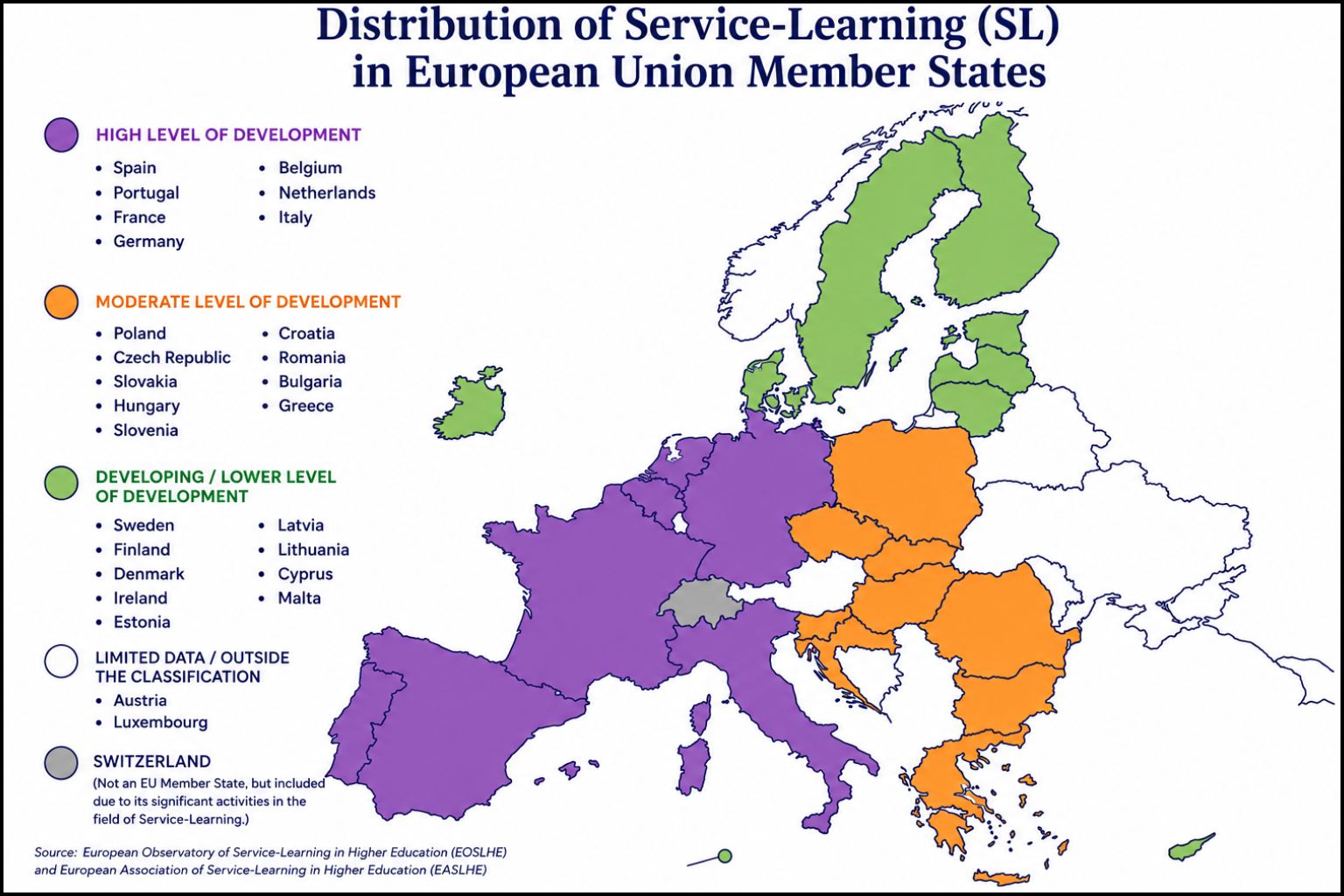
The European Observatory of Service-Learning in Higher Education (EOSLHE) plays an important role in the exchange of knowledge, research, and good practices among EU member states.
Examples of Good Practice in Croatia
At the University of Zagreb, the Office for Service-Learning has been operating for more than six years, providing institutional support for service-learning as a pedagogical approach focused on civic engagement in higher education.
In addition, the Universities of Split and Rijeka have a long tradition of implementing service-learning, with the University of Rijeka placing particular emphasis on learning through community engagement, partnership development, and active citizen involvement.
Benefits of Service-Learning for All Stakeholders
Service-learning brings benefits to all involved parties:
- Students invest their time and knowledge and gain a deeper understanding of course content as well as the challenges faced by the local community.
- Teachers enhance their pedagogical methods and strengthen the connection between theory and practice.
- Civil society organisations participate as co-educators and, through student engagement, achieve their goals more effectively.
Experiences from Previous Calls and Projects
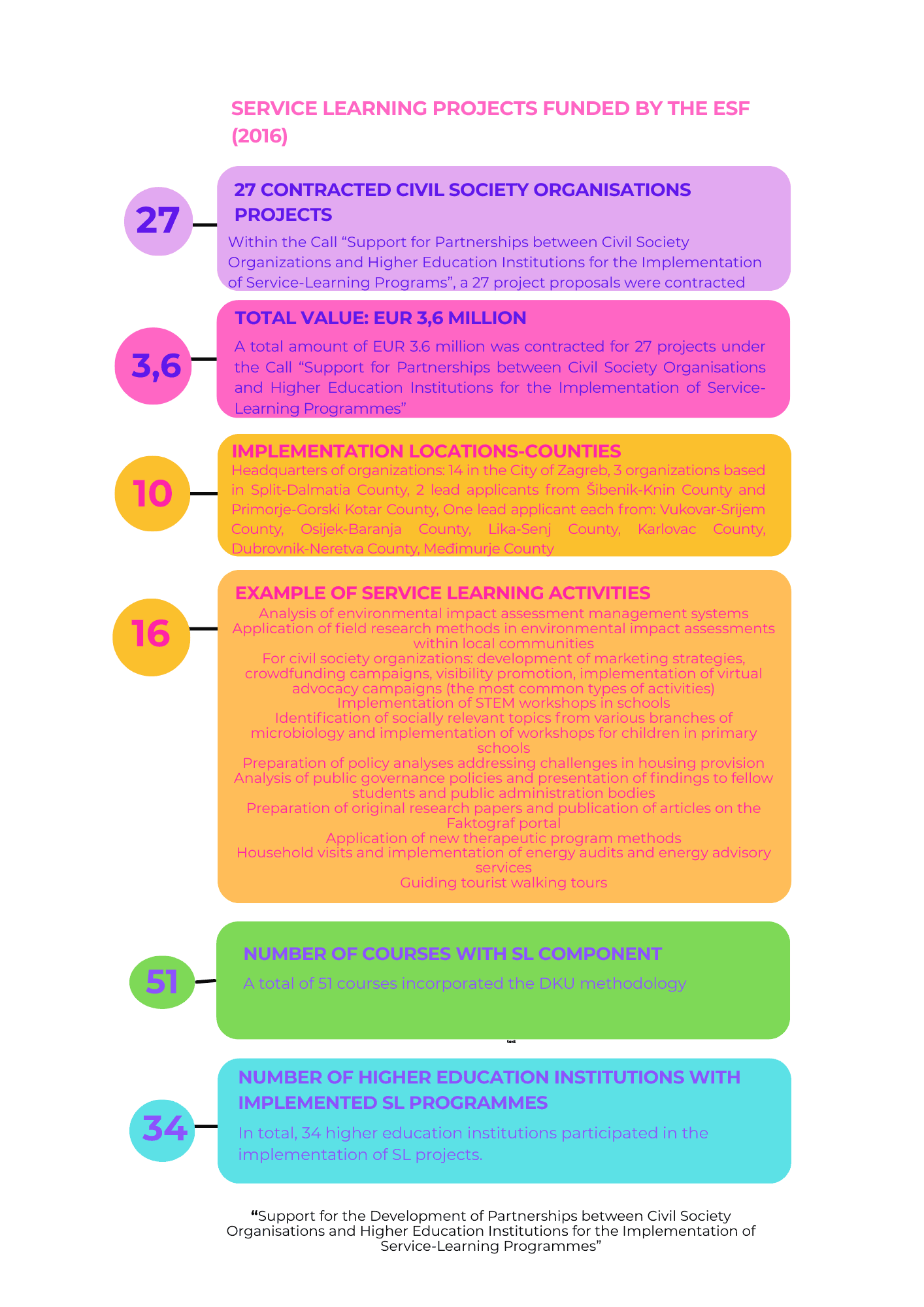
The call “Support for the Development of Partnerships between Civil Society Organisations and Higher Education Institutions for the Implementation of Service-Learning Programs”, launched in 2016, resulted in the funding of 27 projects with a total value exceeding €3.5 million.
Programs were most often implemented in the social sciences. Through 51 courses, students carried out activities such as advocacy campaigns, field research, development of communication and crowdfunding strategies, STEM workshops, public policy analysis, and other socially beneficial activities.
The Difference Between Service-Learning and Student Internships
Unlike calls focused on work-based learning and cooperation with employers—such as the 2025 call of the Ministry of Science, Education and Youth within the European Social Fund Plus (2021–2027) entitled “Improving Employability through Professional Internships in Higher Education”—service-learning is focused on identifying and addressing community needs.
Although service-learning has a strong social impact, service-learning and community-engaged learning programs are still not a mandatory part of official curricula. They are mostly implemented as elective and project-funded programs.
Challenges and Opportunities for Further Development
The experiences of civil society organisations indicate challenges in planning service-learning programs, connecting with higher education institutions, and aligning academic and project timelines. On the other hand, an interdisciplinary approach and networking among students from different faculties have proven to be important advantages and innovative elements of service-learning.
Future development should focus on strengthening institutional support, ensuring more stable funding, and achieving broader integration of service-learning into higher education curricula, with the aim of creating sustainable partnerships and a stronger social impact.
Cooperation Between Civil Society Organisations and Higher Education Institutions
Service-learning (SL) is a teaching method through which students apply the knowledge and skills acquired in a course to projects aimed at solving specific social problems. The goal of service-learning is to enrich the learning process through critical reflection, teamwork, and cooperation with the local community.
Service-learning is not volunteer work, but a curriculum-based form of learning oriented toward the common good. It also differs from professional internships in that it places community needs and social impact at the center, rather than focusing exclusively on professional training.
Service-Learning as a Link Between Education and the Community
Service-learning (SL) is a teaching method through which students apply the knowledge and skills acquired in a course to projects aimed at solving specific social problems. The goal of service-learning is to enrich the learning process through critical reflection, teamwork, and cooperation with the local community.
Service-learning is not volunteer work, but a curriculum-based form of learning oriented toward the common good. It also differs from professional internships in that it places community needs and social impact at the center, rather than focusing exclusively on professional training.
Benefits of Service-Learning
Service-learning provides multiple benefits:
- enables academic knowledge to be used within the community, helping to remove institutional barriers and create new solutions needed by all
- fosters a sense of community belonging, which is important for influencing the further improvement of citizens’ quality of life, activating citizens, and contributing to the development of social identity driven by new ideas
- represents a safe and effective form of community impact, as knowledge transfer occurs directly from students (higher education institutions), through civil society organisations, to citizens
- civil society organisations benefit from up-to-date knowledge in areas such as data analysis, communication, and social media
- the role of civil society organisations is crucial in providing students with opportunities to apply their acquired knowledge through concrete activities in real-life settings
- civil society organisations provide real-life situations for implementing service-learning, as well as professional support and logistical assistance
- the involvement of civil society organisations contributes to the development of students’ skills and the creation of tangible benefits for the local community, while connecting students, teachers (higher education institutions), and the community, shaping new knowledge and contributing to the development of a knowledge-based society
Community-Engaged Learning
1. What Is Community-Engaged Learning?
Community-engaged learning (CEL) is an educational approach that connects academic learning with students’ active participation in addressing real community needs. It is based on partnerships between higher education institutions, civil society organisations, and the local community, with community needs serving as the starting point for designing learning activities.
2. Relationship to Service-Learning
Community-engaged learning is closely related to service-learning but places a stronger emphasis on:
- long-term partnerships with the local community
- joint identification of problems and goals
- the equal role of the community as a co-creator of knowledge
While service-learning is often linked to a specific course, community-engaged learning can be more broadly integrated into the strategy and mission of a higher education institution.