Trends in local community development emphasize a holistic approach, involving local residents in decision-making about their future. In this approach, the individual is the key driver of economic decisions.
Community-based development focuses on empowering local communities to stimulate their own economic growth and development. Sustainable development here means building stronger and more resilient communities that can advance both economically and socially.
Local stakeholders should develop “bottom-up” integrated approaches to address territorial and local challenges, build community capacity for change, and encourage innovation.
Civil society organisations (CSOs) are important drivers of development, offering creative and innovative solutions to local problems.

The Local Economic Development (LER) model of developed economies is based on the assumption that cities and municipalities know their needs best. They are well-positioned to analyze the potentials and challenges of local economic development.
LER relies on partnerships among:
The goal is to strengthen the competitive position of cities and municipalities through optimal use of their own resources.
The European Commission tool, CLLD, mobilizes and engages local communities and organizations.
Today, there are approximately 2,600 LAGs funded by various EU funds, making the CLLD/LEADER model a strategic instrument for:
Goal 8 of the 2030 Agenda for Sustainable Development includes:
To monitor the development of 556 municipalities and cities and 20 counties in Croatia, a development index has been created. It is a composite indicator calculated as an adjusted average of standardized socio-economic indicators, such as:
According to the development index in Croatia:
In underdeveloped areas, there are 13,658 registered associations (31,5% of the total 43,171 registered associations in Croatia).
Civil society organisations contribute to:
Collaboration with public authorities includes:
The priority is to empower smaller CSOs in underdeveloped areas for collaboration and tailored micro-projects for local communities.
Local CSOs often:
First Call (2014) – “Micro-projects Supporting Innovative Activities of Small CSOs for Local Development”:
Second Call (2020) – “Strengthening CSO Capacities to Respond to Local Community Needs”:
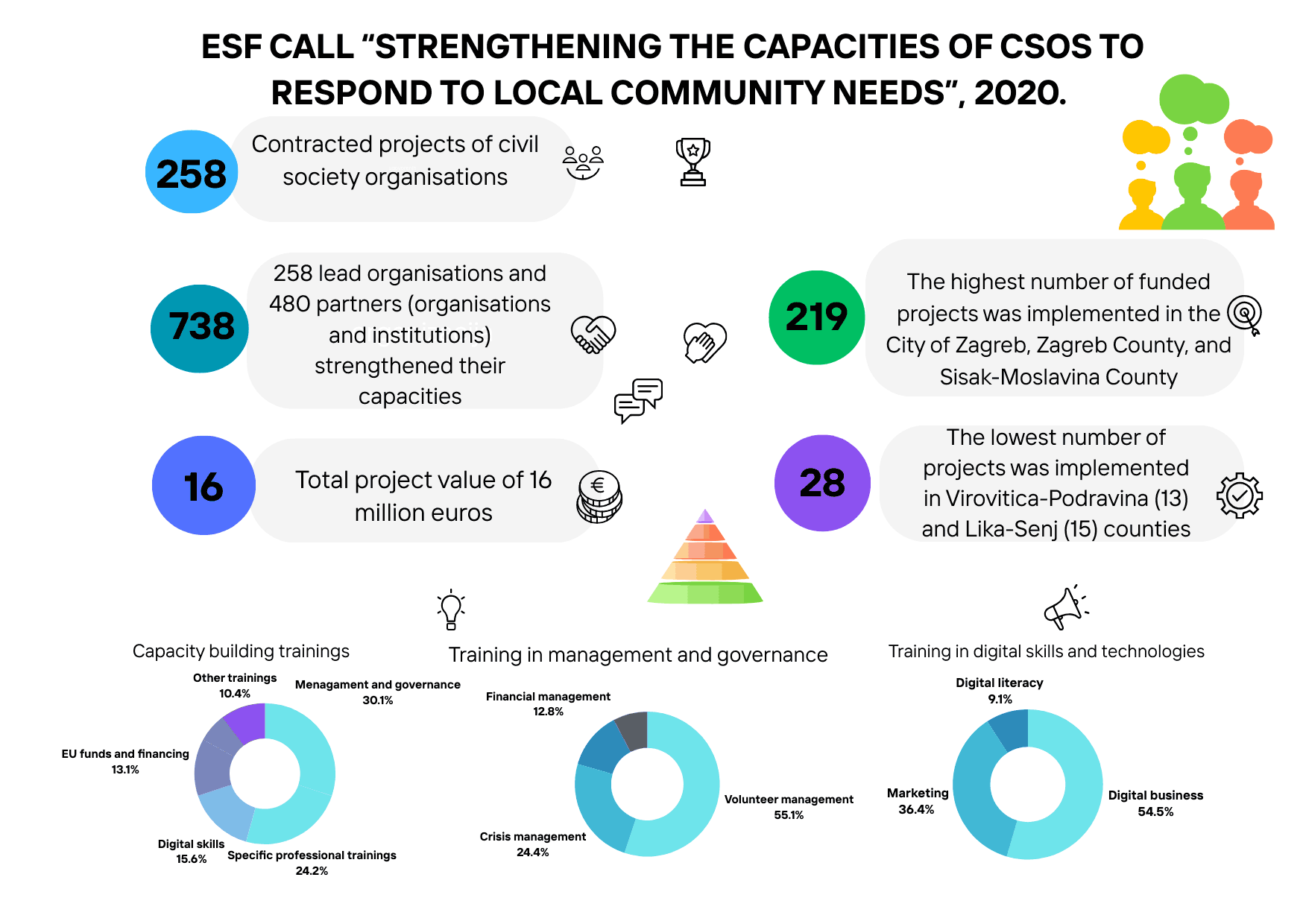
Main Challenges: The lack of funding remains the biggest challenge for activating local communities.