Sustainable development is important because it allows us to meet the needs of today’s society without compromising the ability of future generations to meet their own needs. Key reasons include:
Environmental Protection
Economic Sustainability
Social Justice and Better Quality of Life
Resource Conservation for Future Generations
Global Stability
OVERPOPULATION
If the world population reaches 9.8 billion over the next two decades, the United Nations estimates that nearly three Earth-sized planets would be needed to provide the natural resources required to sustain the current lifestyle of the global population.
INCREASED CONSUMPTION OF BIOMASS, FOSSIL FUELS, AND MINERALS
Predictions for the next forty years indicate that global consumption of biomass, fossil fuels, metals, and minerals will double, while annual waste production will increase by about 70% by 2050.
LOSS OF BIODIVERSITY AND NEGATIVE TRENDS IN WATER CONSUMPTION
More than half of total greenhouse gas emissions, over 90% of biodiversity loss, and freshwater shortages are linked to the extraction and processing of natural resources.
CLIMATE CHANGE AND EXTREME WEATHER EVENTS
Excessive pollution and greenhouse gas emissions lead to rising global temperatures, more frequent heatwaves, droughts, floods, and severe storms. These extreme conditions threaten food security, water availability, human health, and ecosystem stability.
SOIL DEGRADATION AND THREATS TO AGRICULTURE
Intensive agriculture, industrial pollution, and overuse of chemicals cause soil degradation, reduced fertility, and erosion. This results in lower agricultural production, increased risk of hunger, and rising food prices.
AIR, WATER, AND MARINE POLLUTION
Air pollution from industry and transport directly contributes to increased respiratory and cardiovascular diseases. Pollution of rivers, seas, and oceans with plastics, chemicals, and wastewater threatens aquatic ecosystems, fisheries, and human health, while microplastics are increasingly present in the food chain.
SOCIAL AND ECONOMIC CONSEQUENCES
Unsustainable resource management deepens social inequalities, increases migration caused by climate change and resource crises, and creates additional pressures on health, social, and economic systems, particularly in vulnerable communities.
KEY INVESTMENT IN KNOWLEDGE OF SUSTAINABLE DEVELOPMENT
In this context, sustainable development and knowledge of its practical application, as well as further development of education for sustainable development, are key priorities for environmental protection, ensuring a sustainable way of life, and building more resilient societies for future generations.
In 2005, the United Nations Economic Commission for Europe (UN/ECE) adopted the Strategy for Education for Sustainable Development, which is centered around 17 Sustainable Development Goals (SDGs), further detailed into 169 closely interconnected sub-goals as part of the United Nations’ sustainable development program to 2030 (Agenda 2030), adopted in 2015.
Agenda 2030 is a key platform for addressing today’s most pressing challenges across interlinked economic, social, environmental, and political-security dimensions. Due to its comprehensiveness, inclusiveness, universality, and transformative nature, the UN Agenda 2030 and its consistent implementation are of paramount importance to the international community.
Agenda 2030 emphasizes people, planet, prosperity, peace, and partnership, expecting countries to do everything possible, according to their national capacities, to ensure that “no one is left behind.”
The European Commission has developed numerous environmental measures within the European Green Deal strategy, aiming for a climate-neutral, resource-efficient, and competitive economy.
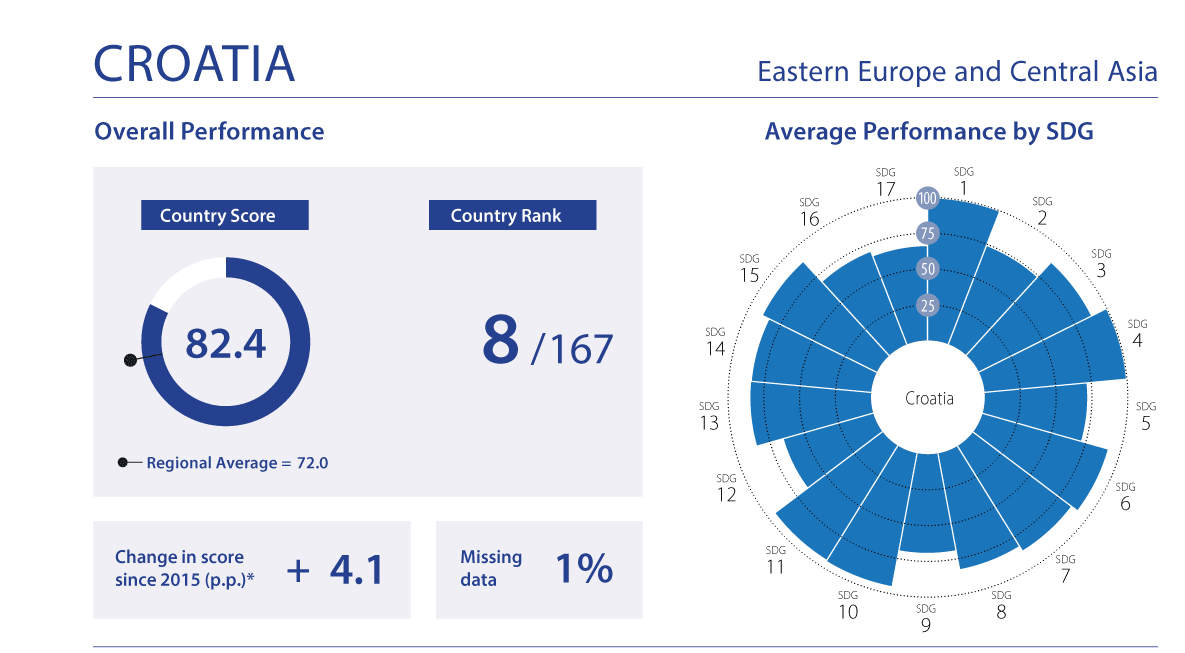
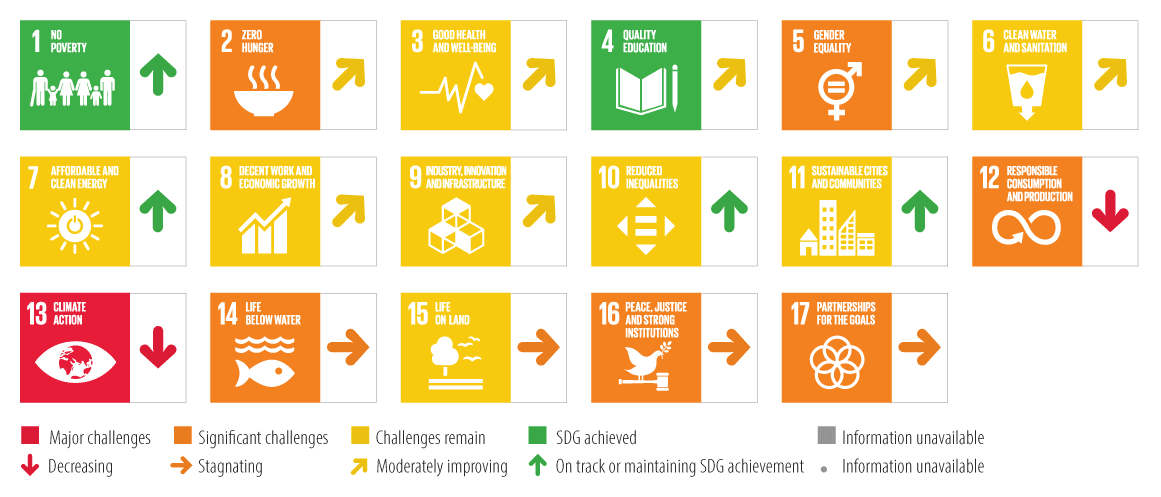
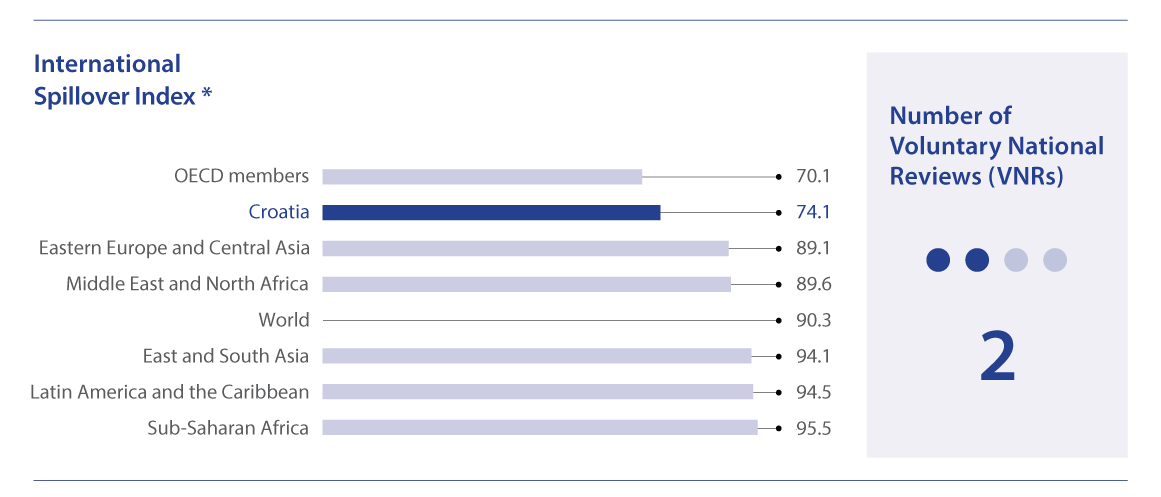
Croatia ranks 8th in the global ranking among 167 countries (Sustainable Development Report).
The Republic of Croatia has made visible progress in numerous areas (Sustainable Development Report 2023), particularly in reducing poverty and social exclusion (SDG 1), ensuring economic growth and development (SDG 8), and implementing policies aimed at reducing inequalities and improving living conditions, especially for the most vulnerable groups (SDG 10).
According to the European Commission’s 2025 report on Croatia, the country is making progress across all 17 SDGs, although the pace and level of achievement vary. For five goals, Croatia is above the EU average, while in several areas where it is still below the EU average, visible progress is noted, particularly in education, employment, energy efficiency, digital connectivity, and macroeconomic stability (SDGs 4, 8, 9, and 17).
Regarding SDG 4 (Quality Education), Croatia lags behind the EU average in several indicators, such as participation in early childhood and preschool education and the proportion of the population with tertiary education. A significant portion of investments from the National Recovery and Resilience Plan (NRRP) is dedicated to the construction and renovation of schools and kindergartens, which will contribute to improving these indicators and support further investments and reforms under the NRRP framework.
Although sustainable development topics are integrated into formal learning plans (primary and secondary schools) in Croatia, some subjects are not equally addressed in quantity or quality (environmental protection and natural resources are more represented than, for example, social cohesion). Additional efforts and contributions from civil society organisations are needed to ensure practical learning, participatory teaching methods, and the application of acquired knowledge.
Croatian civil society organisations act as key intermediaries and knowledge catalysts, helping citizens better understand and apply legal provisions, policies, and best practices for sustainable development while keeping up with global trends and experiences in this field.
They identify, develop, and propose solutions to sustainable development challenges in Croatia at local and national levels, making a significant contribution to building Croatian society as a sustainable community. By identifying, analyzing, and proposing solutions, civil society organisations help shape a sustainable society in Croatia, operating at all levels—from local to national.
They design and implement non-formal education programs that complement school curricula, transmitting additional knowledge on sustainable development to children and students.
Under the First Swiss Contribution, implemented from 2017 to 2024 by the Office for Cooperation with NGOs, 9,855 primary and secondary school students participated in project activities, and 182 non-formal sustainable development training programs were conducted, resulting in 62 models of good practices for achieving SDGs.
Investing in sustainable development education in less-developed counties in Croatia creates new opportunities for children and youth, empowering them to improve living conditions in their local communities. This helps them grow into citizens ready to contribute to positive change in their municipalities, cities, and counties—by creating jobs, reducing depopulation, and preserving natural and cultural heritage for future generations.